

 |
 |
 |
 |
 |
 |
 |
 |
 |
 |
 |
 |
 |
 |
 |
 |
 |
 |


Networking service systems and related standards
According to the OSI model, the LAN protocols are in the lowest Physical and Data Link layers, which are Ethernet, Token Ring, FDDI and ATM (Figure 2-31).
Figure 2-31 Popular LAN protocols mapped to the OSI reference model. Ethernet: Ethernet has been a relatively inexpensive, reasonably fast, and very popular LAN protocol for several decades. It supports IP and most other higher-level protocols. There are three kinds of Ethernet, Traditional Ethernet, Fast Ethernet and Gigabit Ethernet. [56] Traditional Ethernet: This supports data transfers at the rate of 10 Megabits per second (Mbps). The common used technologies in this Ethernet are 10Base5, often referred to as Thicknet, 10Base2, called Thinnet which is one-half the thickness of Thicknet, and 10Base-T which uses unshielded twised pair (UTP) instead of coaxial cable. Segment length is another item which influences Ethernet communication. As some factors such as line noise or other interferences will reduce the signal, a complete single uninterrupted network cable can only span a certain physical distance. Table 2-8 lists these well-known forms of Ethernet technology. Table 2-8 The common used traditional Ethernets[56]
CSMA/CD: All these Ethernet standards use Carrier Sense Multiple Access/Collision Detection, or CSMA/CD, which is the Media Access Control (MAC) mechanism used in Ethernet. Before an Ethernet device sends out a packet, it listens to find out if another device is already transmitting. Once the wire is clear, it transmits its packet and, also, listens to hear if any other devices have started sending at the same time. If this does happen, which is known as a collision, both of them will stop and re-select a random delay time. After that delay, they will send again using the same mechanism. [55] One of the disadvantages of Ethernet is the limit of its cable. It is insufficient to cover medium-sized and large workgroups. Then some other devices are used. One of them is a repeater. A repeater in Ethernet networking is a device that allows multiple cables to be joined and greater distances to be spanned. One popular type of repeater device is an Ethernet hub.[56] Token Ring: Specified in the IEEE 802.5 standard. Token Ring is another LAN protocol which uses a ring topology and operates at 4, 16 and 32 Mbps. In a token ring network, a special "token" is used among each node to give permission to send data. The token is passed along the ring. No transmission is permitted except the node holds the token. When a node receives a token, it can transmit if necessary. After its transmission or there is no data to transmit, it passes the token to the next node along the ring. In this way, network arbitration and conflict avoidance is managed. In a token ring, the position of active monitor is given to each node and is used to recover from a lost token by sending out a new token when there is no token for a specified amount of time. This guarantees the stable operation under high network loads. Also, in the event of an outage or a broken link, beaconing, which is the process of signalling other systems on the ring for an error, attempts to isolate the problem and recreate the ring.[56] FDDI: FDDI (Fibre Distributed Data Interface) is a high-speed network protocol with a transmission speed of 100 Mbps. It can be extended over greater distances (up to 100 km per segment) and is immune to electrical interference. Also, it has a higher throughput potential, no signal emission (for security reasons), and transmits digital data rather than analogue. FDDI can be implemented by using either twisted-pair or fibre optic cable (IEEE 802.8). Taking the advantage of the token ring networks and adding more bandwidth, flexibility and back-up, the topology of FDDI is one of dual-attached, counter-rotating token rings. FDDI is commonly used as a WAN (Wide Area Network) backbone that connects several LANs because of its speed and reliability. However, it is generally too expensive for general LAN use. [56] ATM: ATM (Asynchronous Transfer Mode) is the latest promising LAN and WAN standard with the bandwidth of 25 or 50 Mbps. It is mostly used to connect stations on a campus or across the world as it can be successfully implemented for LANs and WANs to represent data, voice or video. ATM uses cells, small fixed sized packets, comprising 48 bytes of data and 5 bytes of control. This size of packet makes it easier to move data with low latency. [56] Table 2-9 Comparison of LAN Technologies[56]
LAN Transmission Methods There are three kinds of transmission in LAN: unicast, multicast and broadcast. Unicast transmission: A single packet is sent from the source to a destination on a network.
Multicast transmission: A single data packet that is copied and sent to a specific subset of nodes on the network.
Broadcast transmission: A single data packet that is copied and sent to all nodes on the network.
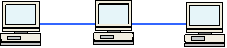
LAN Topologies A LAN topology describes the way in which network devices are organized. There are four common topologies in LAN: bus, ring, star, and tree. These topologies are logical architectures, but the actual devices need not be physically organized in these configurations. Logical bus and ring topologies, for example, are commonly organized physically as a star. [54] Bus: A linear LAN architecture where transmissions from network stations propagate the length of the medium and are received by all other stations. All the devices are connected to a central cable (backbone) with terminators at both ends. This topology is relatively inexpensive and easy to install. Ethernet and token bus are both bus topologies. [55] (Figure 2-32).
Figure 2-32 Some networks implementing a local bus topology. [54] Ring: All devices connected to one another by unidirectional transmission links to form a single closed loop. This link is robust because the failure of one machine in the loop will not cause the entire network to fail. This kind of network is relatively expensive and difficult to install, but offers high bandwidth and is extendable over a longer distance. Both Token Ring/IEEE 802.5 and FDDI networks implement a ring topology[55] (Figure 2-33). Figure 2-33 A logical ring topology. [54] Star: A LAN architecture where all the endpoints are connected to a common central hub or switch. Star topologies are relatively easy to install but bottlenecks can occur in the hubbecauseany machine can send a message, or packet, at any time, causing potential data collisions (Figure 2-34). [55] Figure 2-34 A logical star topology. [55] Tree: A tree connection is identical to the bus topology, except that branches with multiple nodes are possible in this case. It just likes a combination of the types mentioned above (Figure 2-35). [54] Figure 2-35: A logical tree topology can contain multiple nodes.[54] ITU standards for LAN: There are many ITU standards which support multimedia communication over LAN. For example, H.323 is the ITU standard for videoconference which includes H.261 and H.263 video, G.711 and G.722, G.723.1, G.728 audio and T.120 data[14]. |




|
|
|
|
|
|
|
|
|
Designed by Yong Qiu Liu.
Copyright © 2006 All rights reserved